Size of Ngorongoro Crater
Size of Ngorongoro Crater, the Ngorongoro Crater is a remarkable natural phenomenon in Tanzania, renowned for its beauty and diverse species, with its dimensions frequently captivating attention. The dimensions of the crater are a crucial aspect of its uniqueness.
It is not merely a quaint valley, but a substantial, autonomous realm that encompasses a complete ecosystem. Comprehending the crater’s dimensions, including its circumference, depth, and total floor area, enhances one’s appreciation of the vastness of this safari site.
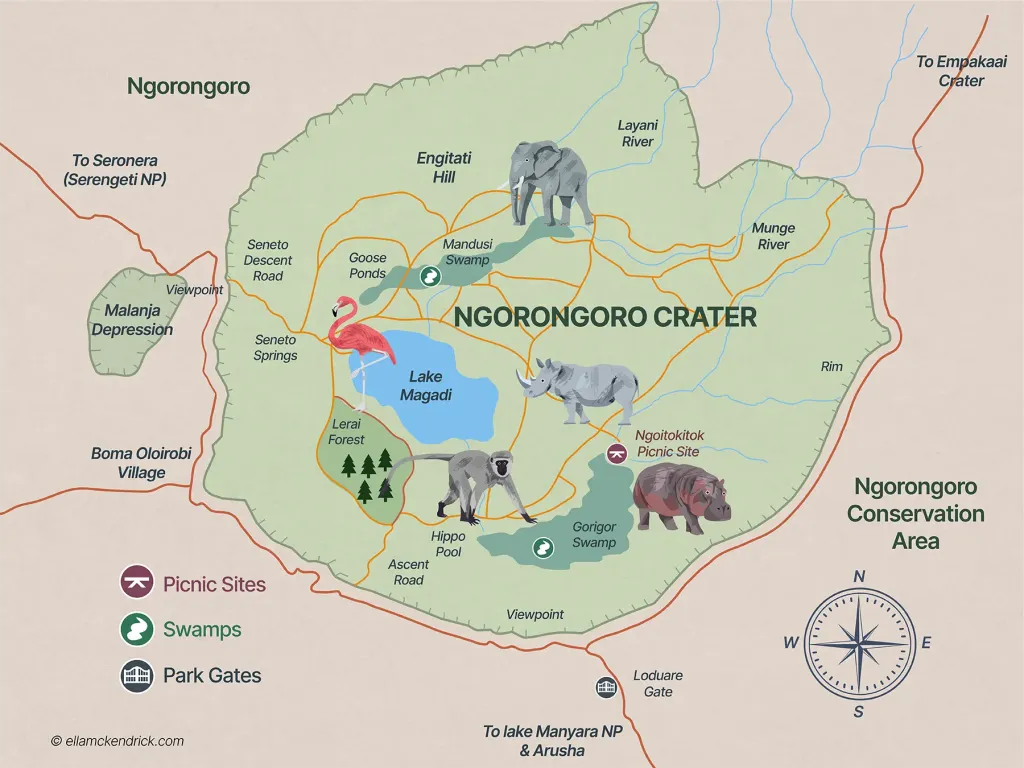
The floor: A vast and diverse expanse.
The key measurement for a safari visitor is the expanse of the crater floor, the region where all the activity occurs. The Ngorongoro Crater floor encompasses an area of roughly 260 square kilometers (nearly 100 square miles). This vast expanse is a significant factor contributing to the remarkable diversity of habitats present within the crater. It is not solely situated on a flat, grassy plain. The floor features a variety of ecosystems, including open grasslands, acacia woodlands, the central soda lake (Lake Magadi), numerous wetlands, and freshwater springs. The diversity of habitats, all situated within a compact space, enables a broad spectrum of creatures to coexist, each securing the necessary sustenance and shelter.
The expansive dimensions of the crater floor ensure that, even with numerous safari vehicles, it seldom feels congested. The fauna are dispersed across the plains, while meandering dirt roads facilitate tourists’ exploration of the various regions of the crater throughout the day. One can traverse for hours from one extremity to another, transitioning from a marsh where hippos are wallowing to a verdant plain where lions bask in the sunlight. The vastness is what renders the safari experience within the crater both exceptional and personal.
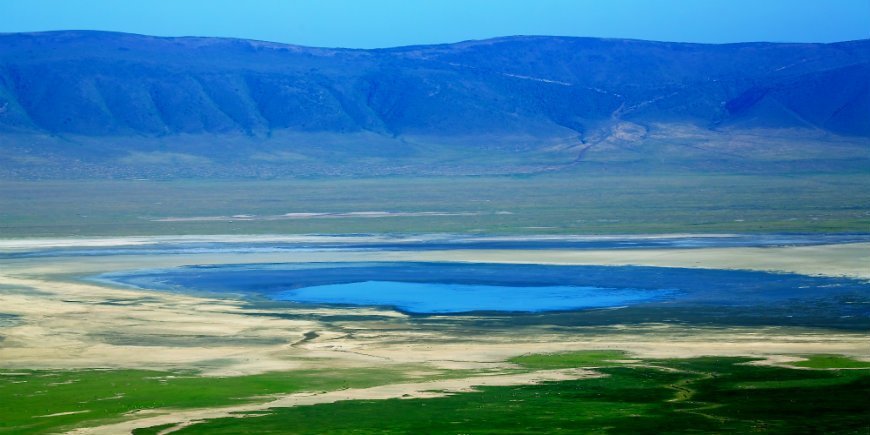
Diameter: A circular world.
In addition to its expanse, the Ngorongoro Crater is also remarkable for its diameter. It spans approximately 16 to 19 kilometers (about 10 to 12 miles) in width. This extensive circular morphology is a direct consequence of its creation. In contrast to a conventional volcanic crater, characterized as a little bowl atop a mountain, the Ngorongoro is classified as a caldera. This indicates it was created when a colossal volcano erupted and subsequently fell inward, resulting in a huge, bowl-shaped depression. The crater’s diameter attests to the immense scale of the previous volcano, which is thought to have reached the height of Africa’s tallest peak, Mount Kilimanjaro, prior to its collapse.
The crater’s round form imparts a distinctly unique character. While traversing the roadways on the crater bottom, one remains acutely conscious of the towering, precipitous walls encircling the area. The sensation of existing within a self-contained realm in a prominent section of the Ngorongoro highlands establishes a natural barrier that, although not entirely insurmountable for the fauna, aids in sustaining a substantial resident wildlife population on the crater floor throughout the year.
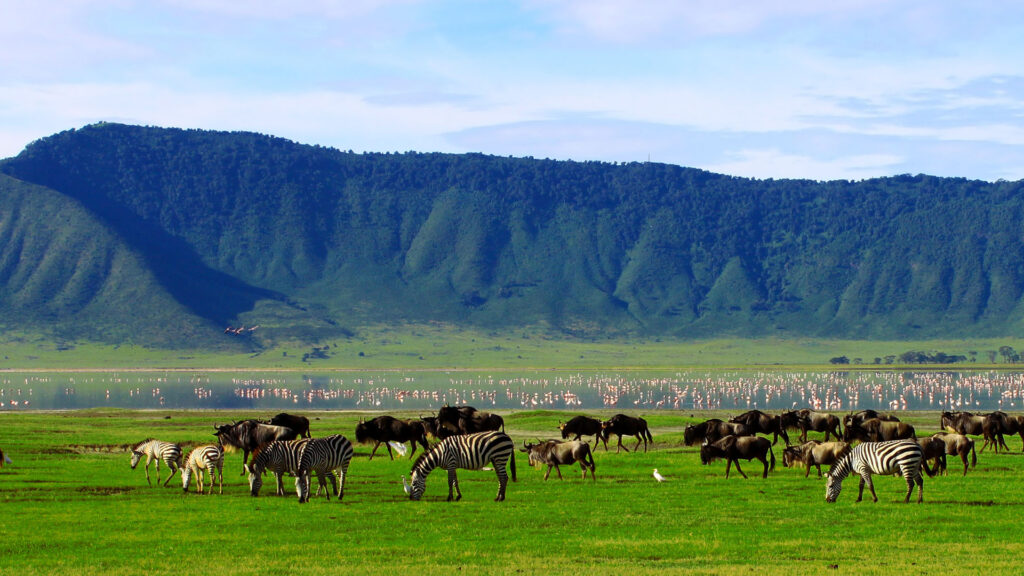
Depth: A natural fortress.
The profundity of the Ngorongoro Crater is another significant aspect of its remarkable dimensions. The caldera walls ascend steeply from the base to the rim, exhibiting a depth between 400 and 600 meters (about 1300 to 2000 feet). This vertical drop is remarkable and enhances the visual grandeur of the environment. Standing at the rim, approximately 2400 meters (7900 feet) above sea level, and gazing into the crater provides a stunning vista of the world underneath. The depth of the craters creates a unique microclimate, while the walls provide natural protection for animals from the winds of the surrounding hills.
Although certain species, like as elephants and buffalo, are capable of ascending the steep walls to traverse the crater, the depth and density of these walls render the voyage arduous. The crater serves as a permanent habitat for resident wildlife like as lions, wildebeests, and zebras. They possess all the necessary food and water, hence there is no incentive for them to depart. The natural enclosure created by the crater’s significant depth is a primary factor contributing to the exceptionally high density of animals, rendering the Ngorongoro Crater one of the most dependable locations in Africa to observe all of the big five.
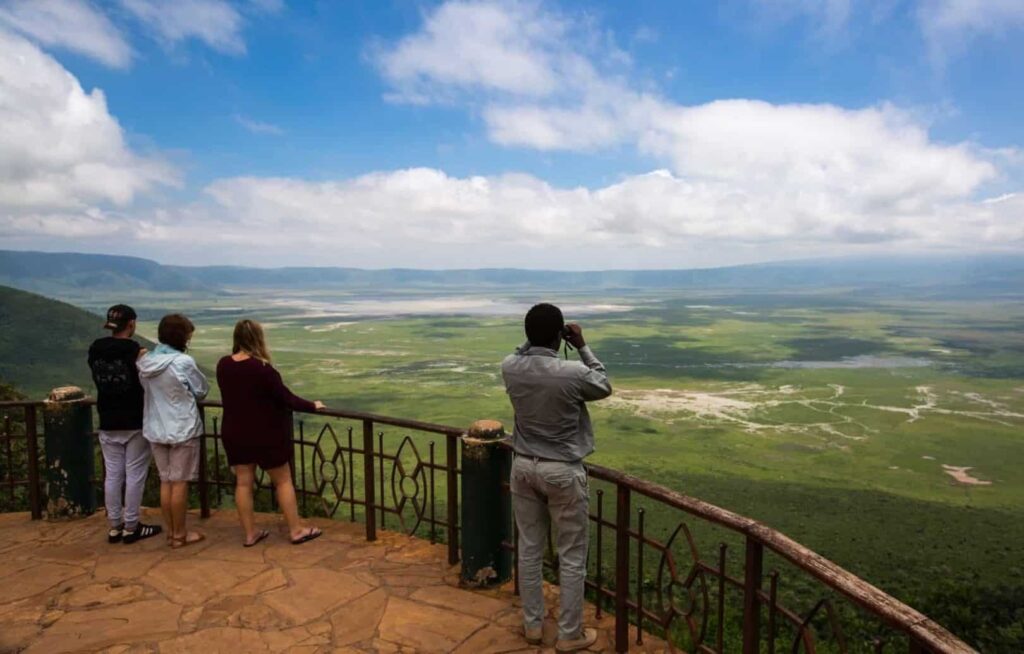
The Big picture: Ngorongoro as part of the larger area.
It is essential to acknowledge that the Ngorongoro Crater, despite its dimensions, constitutes merely a segment of the more extensive Ngorongoro Conservation Area (NCA). The NCA has an extensive region exceeding 8,292 square kilometers (about 3,202 square miles). This expansive region encompasses extensive highlands, the renowned Olduvai Gorge (the Cradle of Mankind), and additional minor volcanic craters such as Olmoti and Empakaai. This crater is the most renowned and hence the most frequented section of the NCA, however its presence is interconnected with a significantly broader environment. The Maasai people inhabit and graze their cattle in the expansive grasslands of the NCA, but not within the crater, which is designated for wildlife and tourism.
Consequently, when discussing the dimensions of the Ngorongoro crater, one is not solely referring to the crater floor. You are discussing the distinctive amalgamation of the vast, geologically important caldera, an extensive and varied biosphere housed inside it, and its role as the nucleus of the significantly bigger protected area. The Ngorongoro Crater is regarded as one of Earth’s greatest natural wonders due to its astounding size and the combination of its defining features.
For any inquiries regarding the Ngorongoro Crater safari, please feel free to reach out to us at All Tanzania Safaris; we will turn your safari aspirations into reality.