Best Guide to Witnessing the Great Migration in 2026
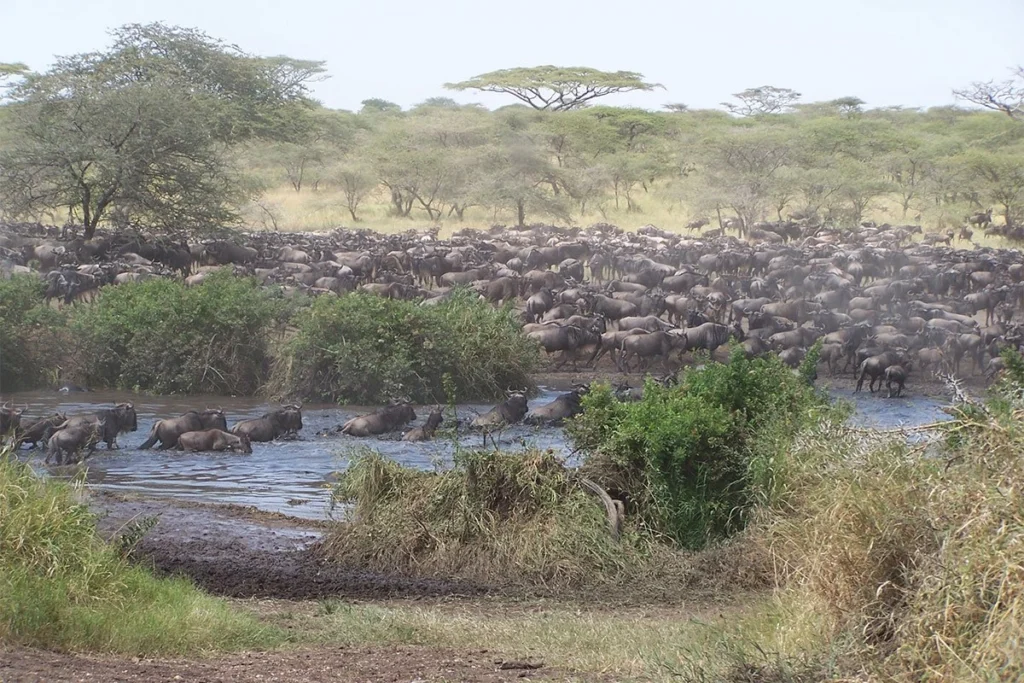
Best Guide to Witnessing the Great Migration in 2026: The Great Migration is a remarkable phenomenon, characterized by the continuous trek of around 2 million wildebeest and zebras, accompanied by gazelles and other antelopes, in pursuit of verdant pastures. The mechanism by which these creatures navigate accurately remains ambiguous.
Some individuals propose that they can perceive rain from considerable distances, but others assert that wildebeest can sense thunder. All these conjectures lack scientific validation. Cease the admonitions: let us proceed.
What defines the Great Migration?
The significant wildebeest migration occurs inside the expansive, grass-abundant Serengeti-Mara habitat, where around 1.5 million animals, including wildebeest and zebra, traverse a traditional route in search of fresh grazing pastures.
Individuals attend to observe the stages of this renowned event, particularly the river crossings. However, each phase is remarkable in its own right. Presented here is a chronological account of this intriguing incident. Let us investigate.
From December until March.
Vibrant, verdant grass emerges in the southern Serengeti with the arrival of rainfall in November. Wildebeest form small herds that focus on the southeastern area and disperse across the Ndutu Plains within the Ngorongoro Conservation Area. The nutrient-dense grass is a consequence of the cataclysmic volcanic eruption of the Ngorongoro Mountains two million years prior.
From January to March, wildebeest produce approximately 500,000 calves. As vulnerable prey proliferates, predators including lions, leopards, cheetahs, hyenas, and wild dogs approach. This is the optimal moment for observing numerous predators in action. Predators also reproduce during this time, when there is an abundance of prey to nourish their offspring.
April to June.
With the onset of April, precipitation diminishes: newly sprouted grass desiccates, compelling fauna to migrate northward in search of sustained rainfall and adequate grazing. They traverse the southern kopje-plains at the Moru Kopjes en route to the Western Corridor.
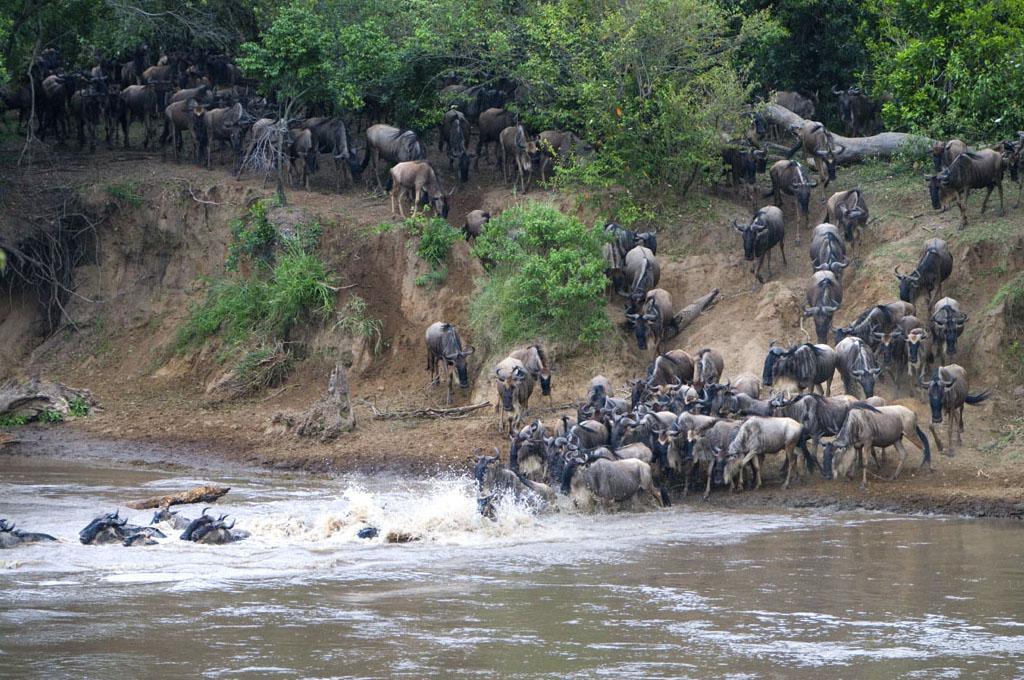
On the western flank, they encounter their initial formidable obstacle: the Grumeti River. In this location, animals possess no alternative but to traverse this river teeming with crocodiles. Some are consumed by ravenous Nile crocodiles, while others fall prey to lions, leopards, cheetahs, and hyenas.
Upon traversing the Grumeti, some proceed directly North, while others join the Grumeti Reserve. They subsequently advance northward into the Ikorongo Game Reserve and ultimately confront the formidable Mara River. Individuals seeking exclusive game drives, including off-road excursions, nocturnal game drives, and bush walks, may reside in the private Singita Grumeti Reserve.
July to October.
Typically, July signifies the commencement of the Mara River crossings. Herds reach the riverbanks and confront the raging currents and voracious crocodiles in pursuit of fresh grass on the opposite side. By August, crossings stabilize as animals recognize their one alternative is to traverse this formidable river.
Crossings occur in both the Serengeti and Masai Mara. The Mara River does not inherently serve as a boundary. It traverses the Serengeti and Masai Mara, enabling observation of these herds from either of the two premier locations in East Africa.
In October, animals disperse around the Masai Mara in search of verdant grazing areas. Consequently, October is optimal for observing the Great Migration in Kenya. Nevertheless, not all wildebeest and zebras depart from the northern Serengeti. Substantial herds can still be located in Lamai, Kogatende, and Wogakuria.
November.
Precipitation commences in the southern Serengeti. New grass and verdant foliage emerge once more. Animals migrate southward through the Loliondo Game Controlled Area and the Namiri Plains (eastern Serengeti) to calve in the nutrient-rich grasslands of southern Serengeti and Ndutu.
When is the best time to embark on a wildebeest migration safari?
Your preferences and financial constraints determine the outcome. The migration is a year-long phenomenon, not a transient occurrence. Consequently, if you visit the Serengeti, you will observe migrating herds traversing the plains. Nonetheless, you can be intrigued by a particular occurrence, like as the calving season or river crossings. The calving season is isolated, attracting only a limited number of visitors to the Serengeti to observe this phenomenon. Moreover, the Grumeti River crossings could serve as an ideal alternative to the notorious Mara River crossings, which are frequently congested. Strategize judiciously.
Essential conclusion.
The Great Migration guarantees spectacular action at every phase. Whether it involves the emergence of numerous infants or significant river crossings, there is enchantment in every phase. Allow us to assist you in personalizing your migrating experience.